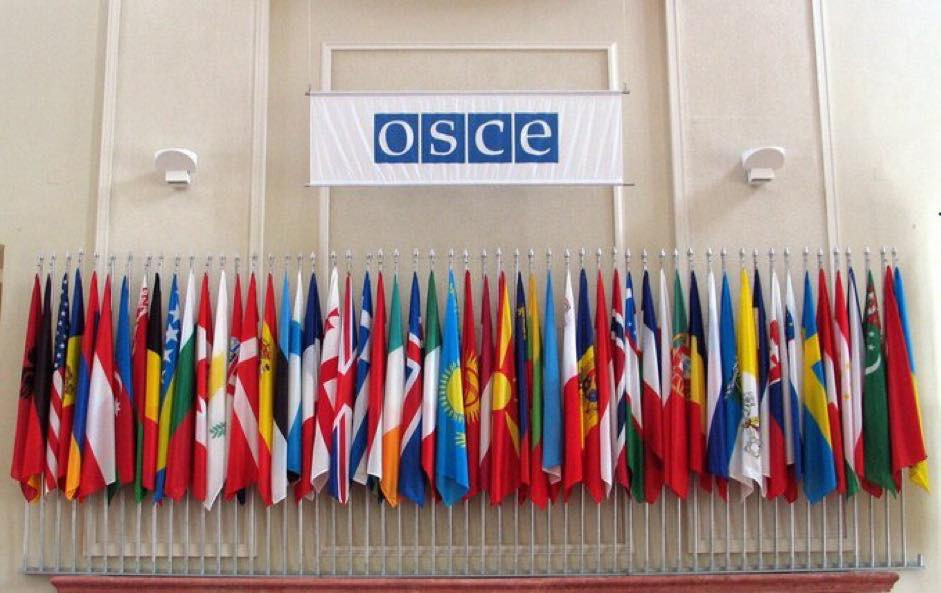
Twenty-four countries have invoked the OSCE’s Moscow Mechanism on January 29, to launch an expert mission on the deteriorating human rights situation in Georgia, according to a statement published on the UK government’s website.
The countries that backed invoking the mechanism include Albania, Austria, Belgium, Bosnia and Herzegovina, Canada, Czechia, Denmark, Estonia, Finland, Germany, Ireland, Iceland, Latvia, Liechtenstein, Lithuania, Luxembourg, Moldova, Montenegro, the Netherlands, Norway, Slovenia, Ukraine, the United Kingdom, and Sweden.
The Moscow Mechanism, part of the OSCE’s human dimension framework, allows participating countries to establish an expert mission to investigate serious human rights violations in any member country. It is administered by the OSCE’s Office for Democratic Institutions and Human Rights (ODIHR). This marks the 17th invocation of the mechanism since its establishment in 1991.
The mechanism is meant “to establish a fact-finding mission to assess Georgia’s implementation of its OSCE commitments, with a particular focus on developments since spring 2024.”
The move follows the earlier invocation of the Vienna Mechanism – another OSCE “Human Dimension” tool to monitor the implementation of human rights and democracy commitments by member states – against Georgia by 38 states in December 2024. At the time, the countries invited Georgia to provide concrete and substantive responses to a number of human rights concerns amid ongoing pro-EU protests.
“We have followed closely and with increasing concern the human rights situation in Georgia.
As an OSCE participating State, Georgia has undertaken to uphold human rights and fundamental freedoms. It has also recognised that respect for human rights and fundamental freedoms is an essential factor for the peace, justice and well-being necessary to ensure the development of friendly relations and co-operation among States.
In December 2024, 38 participating States invoked the OSCE Vienna Mechanism, in order to express concern about developments in Georgia and to request more information. Georgia’s response at the time left unanswered questions about accountability for police brutality against protestors in December 2024 and January 2025. Indeed those acts were at that time assessed as “unlawful violence against citizens…that may amount to torture.” To this day no official has been held accountable for such violence.
Moreover, questions persist about respect for the right to freedom of peaceful assembly, association, and freedom of expression. Since the invocation of the Vienna Mechanism, dozens more Georgians have been detained on politicised charges, including journalists and opposition leaders.
Our delegations as well as others have repeatedly raised our concerns in the Permanent Council, believing the Council is an important forum to promote dialogue and consultations among participating States.
However our concerns about implementation of shared human dimension commitments and international human rights obligations by the Georgian authorities have only increased. On 28 October the Georgian Parliament announced a lawsuit to ban leading opposition parties. Nine opposition leaders have since been indicted and some face up to fifteen years in prison if found guilty. Such a step represents a major escalation in the erosion of democratic norms in Georgia and is incompatible with OSCE principles and commitments.
Our concerns include, but are not limited to: legislative reforms designed to supress dissenting voices and restrict space for civil society and independent media to operate; legal actions designed to ban opposition parties; election integrity, especially in the light of the local elections; active spreading of disinformation by media outlets affiliated to the ruling party; campaigns against diplomatic representatives; constraints on freedom of association, expression and the media; politically motivated arrests and prosecutions; misuse of the judicial system to enforce a system of repression; allegations of mistreatment of persons deprived of liberty; excessive violence and arbitrary detentions; as well as harassment and intimidation of opposition politicians, human rights defenders and journalists.
Recalling that all participating States have committed to co-operative review of implementation of commitments in the field of the human dimension and in particular participating States’ agreement at Astana that “commitments undertaken in the field of the human dimension are matters of direct and legitimate concern to all participating States”, we invoke paragraph 12 of the 1991 Document of the Moscow meeting of the Conference on the Human Dimension of the then CSCE in order to establish a fact-finding mission to assess Georgia’s implementation of its OSCE commitments, with a particular focus on developments since spring[] 2024.
We note Georgia’s response to questions raised in the 2024 Vienna Mechanism and urge Georgia to cooperate with and facilitate the work of the Mission, as per paragraph 6 of the Moscow Document. We recall that in accordance with paragraph 10 of the Moscow Document, one member of the Mission may be chosen by Georgia from the List of Experts for the Human Dimension Mechanism maintained by the Office for Democratic Institutions and Human Rights.
The Mission should give an objective and unbiased report and recommendations, establishing the facts and providing recommendations and advice. It will be tasked, inter alia, to:
- Document recent developments in Georgia in respect of human rights and fundamental freedoms
- Assess the impact of these developments including for Georgian civil society, freedom of the media, the rule of law and independence of the judiciary, political pluralism and other structural components of a democratic society which underpin the OSCE’s comprehensive definition of security
- Provide recommendations on how to address matters of concern.
Bearing in mind the ongoing Russian military presence in Georgia’s occupied breakaway regions of Abkhazia and South Ossetia, the Mission will confine its report to areas of Georgian territory under Tbilisi control. We encourage the Mission to apply a gender-sensitive approach to its assessment.
We look forward to working with the OSCE’s Office for Democratic Institutions and Human Rights on arrangements for the Mission,” the joint statement reads.
Under the OSCE’s human-dimension mechanisms, Georgia has a set period, typically 10 days, to respond to the request about inviting an expert mission. If Georgia declines or does not formally invite the mission, a group of at least six OSCE participating States can instead appoint a mission of independent rapporteurs to visit Georgia and produce a report, without Tbilisi’s agreement on the composition of that group.
Should Georgia accept the fact-finding mission, it can participate in appointing three human rights experts from the pre-established roster.